Lindholme Old Moor (LOM) Management Group
Introduction to the Group and its work
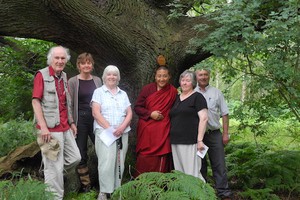
In December 2012 the land to the north of Lindholme Hall was purchased Rangjung Yeshe after the successful Peat (Skid) Moor appeal which raised funds in memory of Dr Peter Skidmore, who made a life-long study of the invertebrates of the Moors. Initially, the site comprised an area called Jack’s Piece but was quickly supplemented by the purchase of additional land to the north of the Gas Well site and the Cottages. The whole of the uncut peatland on the northern fringes of the Island is referred to as Lindholme Old Moor or ‘LOM’ for short. In January 2013, Heather Skidmoor helped to bring together a small group of local naturalists and scientists with a variety of interests and expertise to guide the new landowners in the task of caring for this rare and precious habitat. This became known as the Lindholme Old Moor Management Group. All the members of the Group are volunteers.Members of the Lindholme Old Moor (LOM) Management Group
Paulette Benjamin and David Benjamin are the Gomde UK representatives.}Mick Oliver (MO) has a professional background in mineral planning and surveying and has known the moor for many years. He has been undertaking practical preservation of the site through his tireless drain-plugging efforts.
Dr Paul Buckland has a professional background in geological sciences and archaeology and has a particular interest in the study of fossil insects. He worked with the late Dr Peter Skidmore on Lindholme and has studied the geology and Holocene environment of the moors. He is also a member of the Thorne and Hatfield Moors Conservation Forum.
Tim Kohler joined the group in a personal capacity but has invaluable experience of the site through his work for Natural England. He is Reserve Manager for the Humberhead Peatlands NNR.
Pip Seccombe past President of Doncaster Naturalists’ Society and until recently acted as the group’s Recorder. Pip has interests in botany and plant galls and gall-causers. Colin Wall is a local naturalist who has known the moors for many years, initially as a keen birder but now with a particular interest in with mosses and liverworts. Colin’s wife Glenys took on the role of Secretary when Heather Skidmore stepped down.
Dr Colin Howes was former Keeper of Environmental Records at Doncaster Museum and has known the Moors since the times of William Bunting and the infamous Bunting’s Beavers. Tim Prosser has an interest in meteorology and technology and was co-opted into the group to help with rainfall recording and mapping of the moors. He also helped with the birch clearance and drain plugging work at Lindholme in the 1990s.
Richard Lyon (RL) is a son of Jack Lyon, after whom Jack’s Piece was named. Richard lived at the Hall for many years and has written a history of the Hall and Island.
Paul Collom was land manager for Rangjung Yeshe and LOM member for over two years until 2015. One of his main contributions to the work of LOM has been his handiwork with the chainsaw, helping to clear birch woodland. Kate Stenton has taken over in the land management role.
Andrew Steers is a recent recruit who has provided much needed physical assistance to Mick in his drain-plugging efforts.
Louise Hill (LAH) LOM Management Group Recorder gathering all biological records arising from survey work on the site and forwarding this to Bob Marsh who maintains a Biological Records Database for the Group. Louise is past President of the Doncaster Naturalists’ Society, and Vice County Recorder for VC 63 for the Botanical Society of Britain and Ireland and works as a freelance ecologist.
The aims of the Group
The aims of the group were set out at the initial meeting* To maintain the site as a suitable and viable refugium for the natural and managed re colonisation of Lowland Raised Mire flora and fauna to the adjacent parts of Hatfield Moors SSSI and SAC.
* As a baseline in advance of any future habitat management, to compile an inventory of the organisms including the Rare, Scarce, Red Data Book and Protected Species occurring on the site.
* To monitor and if possible manage populations of the Rare, Scarce, Red Data Book and Protected Species occurring on the site.
* To monitor and manage the water table across the site (by dip-wells; by controlling run-off; and by reducing arboreal transpiration) to enable the site to function as a Wet Mire and Wet Sandy Heath.
